h1

World Wide Web

May 28, 2010

Coffee is my drug of choice. When new students enroll in my class I ask them their drug of choice. It’s part of our intake questionnaire. Caffeine is not an option on the form.

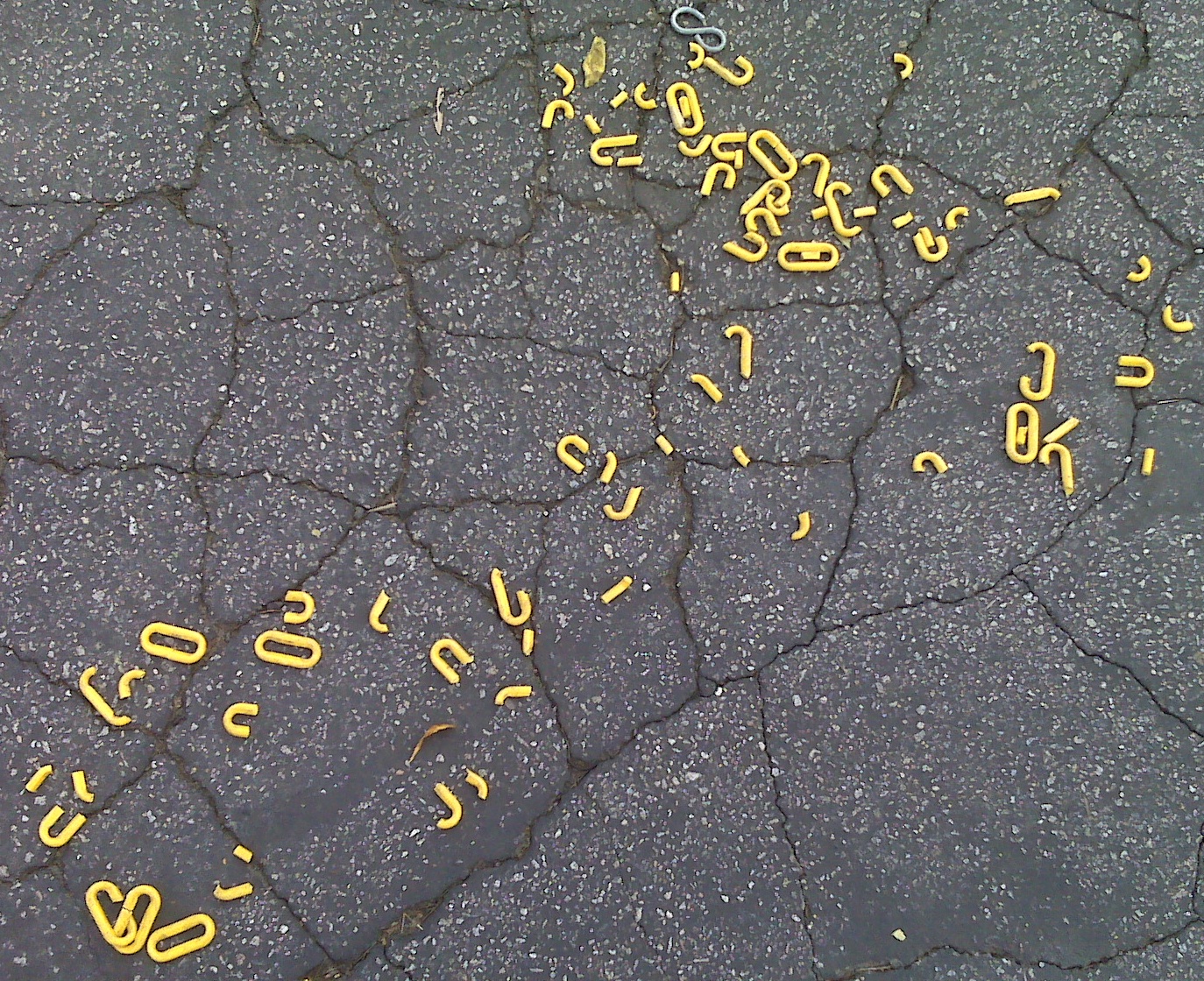
P.N. Witt, a German pharmacologist, researched the effect of caffeine and other psychoactive drugs on spiders in 1948. The study was repeated by NASA in 1995.  I am astonished by the haphazard shape of the web built by the caffeinated spider. It has no center, no focus; it’s the result of effort without a clear definition or structure. It’s me at work multi-tasking.

I know what you are asking. How did they get the spider to drink so much coffee? Actually, ” The drugs were administered by dissolving them in sugar water, and a drop of solution was touched to the spider’s mouth. In some later studies, spiders were fed with drugged flies.” The jury is still out on whether coffee is good for us or not. But I couldn’t weave this here web without it.


h1

Let the games begin

May 25, 2010

Our local rehab, recovery and treatment centers recently competed in Olympic-style games. In my opinion, the methamphetamine addicts clearly have an edge over the heroin users, but the crack team is definitely in the running. The guy who smoked too much PCP — he’s off fishing, hates this kind of thing. My student Yvonne brought home the gold in track and field. I thought she was going to run from the community today, she was so wired from the games. I heard we also took some kind of medal in chess. Yes, the recovery games also feature chess.  Some of my students spent time in prison playing chess and they are very good players. Most of my students just went to hang out. One remarked they ran into someone they haven’t seen in many years, also back in treatment.

Several of my students are complaining to me about how messy their roommates are. They have to cohabitate in very small dorm rooms. Why not make cleaning a competition? Who will take the gold in running the vacuum? Or how about a triathlon of vacuuming, dusting and cleaning windows?

h1

Police blotter

May 21, 2010

Today my Diogenes, who has turned out to be a pretty terrific student, asked if he could write a letter of intent to be allowed off property. He asked me to print a copy and I was so struck by it I read it aloud.  “It reads like a police blotter,” I said. Here is an excerpt:

On May 13, 2010, on a Wednesday, Vincent, Fernando, and Emilio went to a book signing at the Library. During the reading these three students spoke out and asked questions during the Q&A.  A teacher at a charter school approached them to see if they would like to be guests at her school to speak to the kids about gang prevention. The teacher offered to pick up the students and bring them back.

Diogenes, your case is convincing. I hope you get to speak at the school.

h1

Reading – the great escape

May 17, 2010

“Four policemen, frowning and looking at their watches, stood on the front steps of the hotel. One of the officers held two pairs of handcuffs, and another had two heavy chains slung over his shoulder.” We are reading aloud in a small circle in my classroom.  My students are all ears and everyone in the room at the computers is listening too. Is this a news story of a notorious criminal about to be arrested, a murder mystery, a Patterson novel? Far from it, we are reading a biography of Ehrich Weiss, known today as The Amazing Harry Houdini. We read about Ehrich’s early exploits charging the neighbors to watch him tightrope, tricks he learned working for a locksmith, and how he hustled selling flowers on the streets of New York.  We learn that his immigrant father, once a respected rabbi in Hungary, loses his job because of his heavy accent. I ask my students if they know what a rabbi is? One answers, “A teacher.” That’s right, I say, a leader and teacher of Judaism.” I tell my students that it’s a good thing Houdini’s family came to America in the late 19th Century.  If not, I say, Houdini might never have escaped anything. I feel that way about my family, I say, as I show them a tiny dot on a map of Russia; they got out long before the rise of Hitler. “Are you Jewish?” Ronald asks. “Yes,” I say. “You rich?” he murmurs. I just smile and roll my eyes, like “I wish.”

I often forget how street-smart my students are and at the same time most have never left the neighborhoods where they grew up. I may be one of the first Jews they’ve ever met, or at least the first who’s ever talked to them about being Jewish.

h1

Jaded, harlequin, fable

May 14, 2010

Terry is getting ready to leave the program. She is already off parole and trying to secure housing. Terry is transsexual, male to female. She’s beautiful in the most androgynous way, both delicate and handsome. I made it clear from the minute I met Terry that she was safe in my class. There would be no off-hand remarks, no sotto voce slanders from the other residents; there would be lots of freedom to “play school” as Terry called her time in class. Terry sometimes picked out vocabulary words for our class, flipping through the pages of the big red Webster’s, and I’ll miss this. Who could resist her flair for spelling lists that included: jaded, harlequin, fable, bottomless, astride, gadabout. Today, my supervisor told me I need to start teaching vocabulary that appears across the curriculum, words like dependent, challenge, and adjacent — boring!

h1

Sunday Brunch

May 11, 2010

On Sundays, I am not at the Rehab. The residents wake up to a sweet roll and coffee at 8am to hold them over till the big Sunday Brunch. They then receive visitors and can do activities such as read, play dominoes, shoot hoops, or watch the game on one of several jumbo flat-screen TVs. Chain gang or Sunday Brunch, there needs to be something in between. Shouldn’t rehabilitation involve more giving back? Break into a house then you have to help build a house for someone else. Steal a car, then you have to repair a hundred potholes. Deal drugs? Plant and tend a community garden. You get the idea. To my students’ credit, they are all required to give volunteer hours at the rehab — kitchen, groundskeeping, cleaning. So at least they’re whipping up those mile-high pancakes themselves.


Sunday Brunch

h1

Cap and gown

May 6, 2010

Wanda got her GED! She was waiting at the door of my school when I arrived Monday morning. We dressed her in the spare cap and gown I keep on hand. “Put the tassel on the right,”  I said. We shuffled out to the garden and I snapped her photo next to a wall of pink flowers.  This was the first time Wanda had ever worn a cap and gown. Statistics show that getting a high school diploma greatly increases a parolee’s chances of not going back to prison. I had five students who only needed to pass the math section to get their GED. Two walked out of the program (Damien and LaDeena), one went home (Marcos), and one is still here and will hopefully finish. But Wanda did it.

h1

Everyday life

May 6, 2010

Traffic has been light in my school the past few days. Yesterday, I only had two students after lunch. Both of these gals, in their 40s, are low-level readers — between fourth and sixth grade. I busted out my new set of easy readers, choosing one titled Reading Changed My Life, which contains three true stories. I sat with my students at a circular table and we began to read the one told by a Mexican woman who comes to the United States as a child in a migrant farm family. Poverty, abuse, and violence pervade her story. Her father is an alcoholic who beats her. She marries a man who raped her and has a daughter. Growing up poor and itinerant she never learned to read. However all that changes when, after leaving her husband, she picks up her young daughter’s Dr. Seuss books and starts teaching herself to read. It nearly brought me to tears working with my students, helping them to brave reading aloud. For me the saddest part was not the horrors of the story we read together but the fact that my students see this is as everyday life.

h1

Odyssey

April 29, 2010

I have a new worry about ordering the classics for my students. The old concern was that the antiquated language might turn them off. It turns out I missed a meeting where teachers were informed that the language in the novels on the list we can select from has been “modernized and simplified.” For example, in the crucial last paragraph of Homer’s The Odyssey, the line, “Odysseus obeyed Athene’s words, delighted at heart,” has been reduced to “Odysseus obeyed her gladly.” All this of course translated from the original Homeric Greek. I’m all for getting my students to read; the little bookshelf space I have in my class is at capacity. But to lose the poetry of Homer — having Odysseus cheerfully follow instructions as if he were talking to a receptionist at the dentist’s office — I’m not down with that.

h1

Shark sticker

April 28, 2010

The student I call Diogenes now has over 20 hours in class. He is fiercely independent. When I assigned him a five-paragraph biographical essay he wrote about Patsy Cline. He pokes his head into class five times a day but rarely spends more than an hour inside. He got 100% on his spelling test today so I gave him a shark sticker. I saw he put it on his thermal coffee mug. I appreciate when a former gang member softens over an incentive as small as an aquatic-themed sticker. Though he is bound to be off task and chatty and a bit disruptive, I no longer dread having this student in my class. One must celebrate small victories.