 August 12, 2013

Peter came back to school today all chatty. Mr. Disclosure announces to the class that he’s got a bracelet on his ankle, a GPS device that tracks his movement 24/7 and is permanent till parole removes it. The device alerts his agent when Peter is in a “bad’ neighborhood. So he tells us he was at a crack house when his GPS device starting buzzing and vibrating. That means he is supposed to call his agent immediately. When the group he was with heard this they scrambled, yelling, “The police are coming!” Peter says the house emptied out and everyone left their rock cocaine. He says he just swept it all up and went on his way. Someone asks, “So the device they strapped to your ankle to prevent you from doing drugs actually helped you get a bunch of crack?” “Yep,” he says and goes back to reading. Now I know why Peter’s on restriction at the rehab. He tested dirty for a lot of cocaine.
Posted in adult education, GPS bracelet, parolees | Leave a Comment »
December 29, 2012
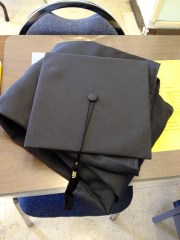
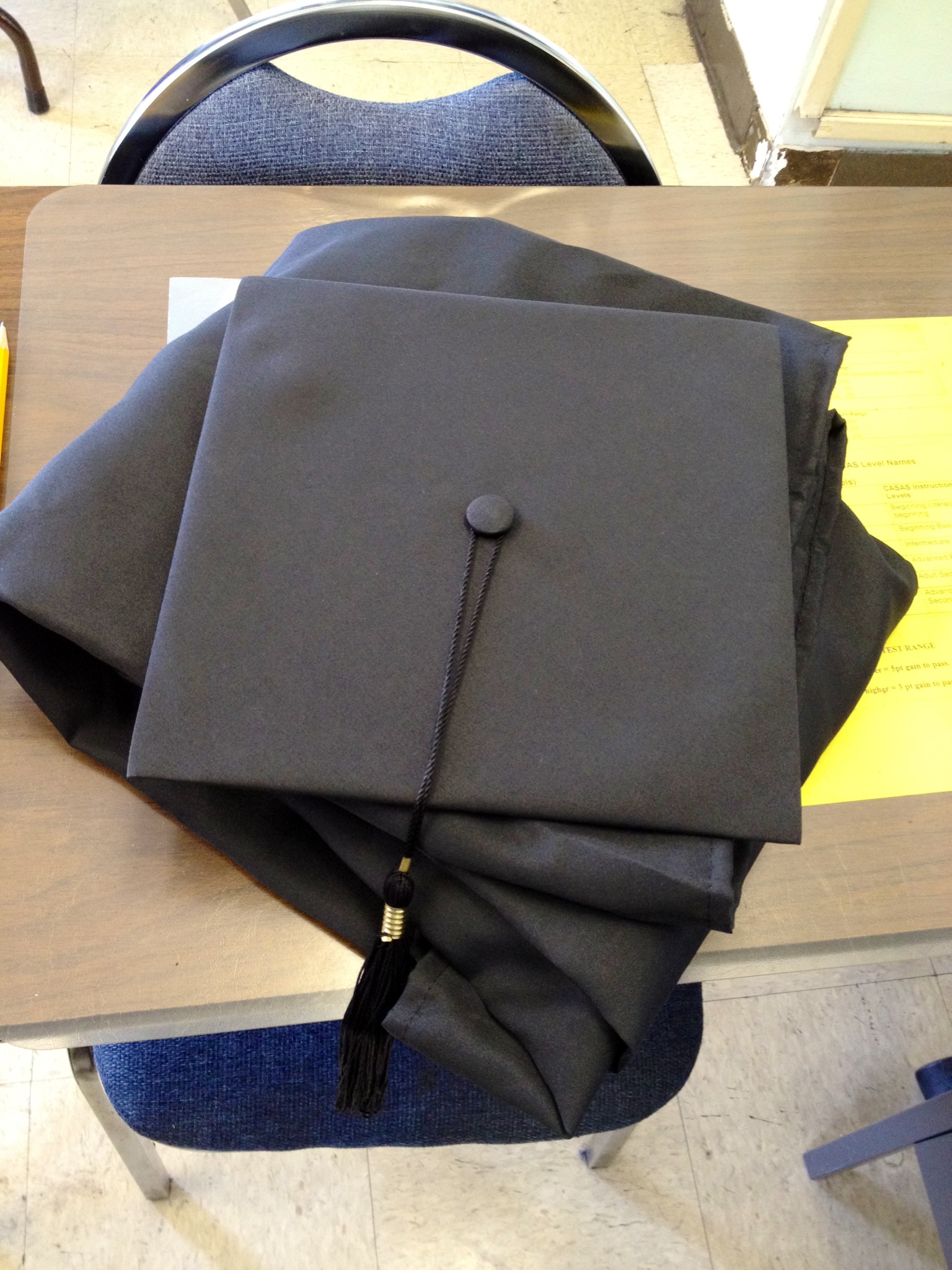
Edgar made it to the GED and passed! I brought the class cupcakes. Then Edgar went home on a weekend pass and decided to celebrate his achievement by going on a methamphetamine binge. He crawled back to me looking a bit unshaven, the young man with the perfect goatee whom I had photographed in cap and gown just a week earlier. I admit I was disappointed in Edgar. Wasn’t the diploma enough? I have to re-enroll him so I gave him his former intake sheets to check. When I reviewed them later I noticed he left his grade level at 9th grade, didn’t bother to check the box for GED.
Now that Edgar has his GED I have to design a different curriculum for his 40 hours, the mandatory required in our particular program. It’s difficult to help someone climb a ladder only to have to pick them up again at the bottom. How do you make that ladder appealing now? Edgar told me he wants to move to Alaska when he discharges parole, to work in the oil industry. So I told him, “You need to read the classics,” and handed him Jack London’s Call of the Wild. I also directed him to an online literary guide that outlines the book’s characters and setting, with discussion and questions. I’m not finished helping Edgar but he’s got to help himself, break from the pack, the streets, crystal meth.
Posted in adult education, drug recovery, education, GED, meth | Tagged GED, parole, rehab and recovery, Self-help | Leave a Comment »
May 1, 2012
Xavier never made it to the GED. I urged him to go register at the local adult school, he had the check in his pocket. What was he waiting for? How could I help? These past few weeks I would glimpse him through my classroom door, sneaking past in the hallway. He would be heading up to his room or going out supporting others to get their errands done. And he never missed a day of softball practice. The only time I’ve been able to catch him is Tuesdays and Thursdays when I’d hear the metal clatter of aluminum bats and the thud of the big canvas bag of leather mitts being pulled out for the team.
I had gotten Xavier’s test funded with urgency because he is due to leave the program soon. After he got his $150 check, I needed back-up getting him to move forward, so I wrote the director that Xavier had test jitters, that he was sitting on his check. It turns out the check they issued was only good for ten days. By the time I reached out to Xavier again the check had expired and he was being tested for drugs. None of this comes as a surprise, it’s all too common.
Today Xavier came in to say he was sorry. He told me with a big grin he will still be allowed to play on the in-house softball team after he exits the program. “And you can still take the GED,” I said. The sparkle in his eyes dissolved. I guess a high school diploma just doesn’t hold the same magic as baseball. There may be more than one field of dreams but it’ll always be little league without a diploma.
Posted in adult education, GED, parolees, rehab, relapse, students | Tagged GED, rehab and recovery, test jitters | Leave a Comment »
April 17, 2012
In the school where I work, every new student must go through an intake process that includes me asking them questions about their drug use and criminal history. The forms I fill out are important to the tracking and funding of our program and I always see this initial interview as an opportunity to get to know my students. On some days their words start to wash over me as the clients at the rehab often digress into personal tales.
“I have a detective coming to talk with me about being raped.” “I used meth and PCP together.” “The car accident, I can’t remember well.” “Seizures.” “I’ve been shot.” “I’m not here for drugs, I’ve had a terrible loss.” No one tells me they shot, robbed or beat someone — confessing their own misdeeds is a thin line few cross.
I have to remind myself that I am here to teach these guys and gals reading, writing and arithmetic. I’m not a social worker or a counselor, but I’m still empathic, intaking it all personally.
Posted in adult education, community, crime, drug recovery, education | Tagged parole, rehab and recovery | Leave a Comment »
March 13, 2012
(Fast-forward: I am now teaching in a treatment center serving homeless men and women on parole)
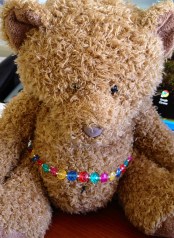
I have worked in other drug rehab facilities where adults toting stuffed animals were the norm. In the mid-1990s I subbed in a hospital treatment center for juveniles where the residents were required to carry a stuffed animal the first 30 days of the program. Stuffies make us feel secure. Using a teddy bear is healthier than using drugs or alcohol, which many do to suppress their emotional insecurities. So I wasn’t surprised when Xavier showed up today with a well-worn teddy bear wearing a rainbow necklace around its belly.
Xavier is my strongest GED candidate yet. But I have had to refer him to a therapist for his suicidal thoughts and depression. He is so strong in math and reading that I am having him read self-help books to boost his confidence rather than sit drilling on geometry.
It’s a fine line between success and failure for this population. They often don’t follow through at the last minute. They don’t just get cold feet, they get frostbite requiring amputation. I’m hoping I can get Xavier funded to take the GED in April, that he will complete his diploma. Convincing the GED examination board to let him bring in a teddy bear is another story.
Posted in adult education, drug recovery, GED, parolees, rehab | Tagged GED, Self-help, Teddy Bear | 1 Comment »
March 13, 2012

(Returning to my blog after nearly a year hiatus. Still teaching, sometimes writing. Thanks for reading. I wrote this last year, just posting it now.)
Today I am sitting with one student. I am no longer at the rehab. My site lost its funding and my school relocated to this parole office where most of the students are required to attend or go back to jail. The student with me this morning wears a tie-dyed t-shirt. He has nine more hours to complete. Coming to my school is his get out of jail free card. He is a lifelong follower of the Grateful Dead, even post-Jerry Garcia. He grows and distributes medicinal marijuana, sampling his inventory, no doubt. Parole agents found two grams of Ecstasy in his house. Why do I feel like I’m in San Francisco and it’s 1968? He just wants to be left alone. Parole and my program are of no consequence to him.
What’s that rustle at the sign-in sheet?
That is my only student leaving early.
Posted in adult education, arrested, parolees | Tagged education, Grateful Dead, marijuana | Leave a Comment »
March 27, 2011
Randall had been at the rehab for years. He was a youthful-looking African-American in his forties who dressed like a kid. To me, It looked like his mom had picked out his clothes, typically plaid shorts, a crisp white polo shirt, and tennis shoes. His clothes always looked new, right off the rack. His drug of choice, heroin. He had worked his way up the ladder in the community, making sure, during hourly monitoring, that everyone was accounted for; manning the reception desk; answering phones; and eventually becoming a role model. In order to advance to intern, he had to have his GED and he studied sporadically in my school to take the test.
Randall is bright and he worked hard, passing the pre-GED in all five subjects. I recommended he be funded by the program to take the test, and he registered for for it. The morning of his test I saw him smoking out in front of the rehab. He told me he went to the testing center but was the only one who showed up, so they rescheduled the math and writing for next week. The odd thing is I believed him. After ten years working with parolees I somehow didn’t have my “cheater meter” up and running. Two days later coming in to work I saw his name on the board that lists the names of residents who split or were kicked out. Randall had left in the middle of the night. I called the GED testing center and they told me they’d had a full house for that week’s math and writing exam. Damn. My heart dropped.
It’s common for prisoners to mess up right before their release or to work toward a goal and sabotage it. They say success is the hardest thing for this population. Increased expectations, increased responsibility, increased fear. About the same time Randall left, most likely relapsing on heroin, I received a new student, Geraldo. Geraldo scored 100% on four of the five pre-GED tests. This is unprecedented in my experience. I immediately recommended him for the full test and he is set to take the GED next month. this time I’m not keeping my fingers crossed. Geraldo exceeds my expectations and I have no fear that he will succeed.
Posted in adult education, community, GED, parolees | Tagged parole, rehab and recovery | Leave a Comment »
December 30, 2010

Yesterday marked one year since I started Parole Call. My goal was 100 posts; counting this one I wrote 77. Anniversaries are funny things in my line of work. Mostly everything my students — all felons on parole — recognize as a milestone is followed by the statement, on the outside. “This is the first birthday/Christmas/Thanksgiving I’ve spent on the outside in X many years.” I’ve never heard anyone say, “This is the first anniversary of my not stealing.” Maybe we should honor the passage of time from iniquity as well.
So this is my first anniversary of blogging. I have learned a lot about my work through this process of written reflection. I realize I spend all day helping people see their potential, celebrate small victories, and recognize incremental growth in themselves. But I also see humanity in turmoil, locked into destructive patterns, unable to break away from drugs, poverty, and the grip of mental illness. My work environment is never boring. On any given day when I walk into the greater rehab, there is likely someone yelling, getting yelled at, crying, laughing, ready to walk, steaming mad, or heartbroken. I see people in survival mode, working the system for food and shelter. Some students leave without completing the program and come back years later, fresh out of prison all over again. I might see a former student sitting on the couch near the intake desk, black-eyed, thin and homeless. “Welcome back,” I say. “I hope you will come back to school, we missed you.” It’s about a thimble of hope.
Posted in adult education, community, parolees | Tagged hope, parole | Leave a Comment »
November 22, 2010

It’s the week of Thanksgiving and the community is busy cooking more turkeys in a week than most of us will in our lifetime. Many of these are being prepared for a local homeless shelter. All the women were missing from my class today. Someone said they were out together getting their hair done. I wonder what beauty school they went to or if a salon donated their services. It’s the first I’ve heard of this in my many years teaching at this site but no field trip would surprise me. Sometimes this place does feel like summer camp for felons. One wonders why anyone would ever leave.
Bart left this weekend. He didn’t seem restless on Friday when he was in my class. Sometimes a resident will leave just before a holiday to try to see their family or their dealer. Last week Bart drew me a lizard resting on a melting eyeball for the small gallery I have of student artwork. He might still be using his drug of choice, LSD. Bart claims to have taken LSD more times this year than the number of turkeys we are cooking.
Posted in drug recovery, parolees, relapse, students | Leave a Comment »
November 12, 2010

One of my former students returned this week. Bart was in my class in 2008. I remember him getting close to taking his GED right before taking off. Everyone likes Bart. Barely out of his twenties, he makes eccentricity seem cool right down to his blond mohawk that turns into a long pony tail. Since I last saw him Bart has been working on expanding the holes pierced in his ears. Yesterday he walked in with two AA batteries in each lobe. “Have a look in your junk drawer, Ms. P, ” he said. He wanted me to find him something else to put in the holes now stretched to nearly an inch in diameter. “Inside I used chess pieces,” he said of his time in prison. “Queens because the kings were too big.”
I try to withhold even the simplest supply request lest word get out in the community that I am soft and can be milked for goods. I never let parolees use my office phone or borrow money, not even a quarter. If you give an inmate a paper clip in prison you can lose your job. It’s a matter of safety and security. Here are some items I did give out this week: pencils to do math problems, an envelope to send for official GED transcripts, a rubber band to hold together a student’s dreadlocks so they don’t fall in his eyes during computer work.
Stuffing your ears with batteries can’t be good. So I found a dried-out orange highlighter in my desk and gave it to Bart. The next day he came in to class with the highlighter’s plastic orange barrel neatly cut into fat, hollow pegs that he proudly wore in each earlobe. Then he watched a skateboard video on Microsoft Encarta. I saw it was too late to ask for my highlighter back.
Posted in adult education, GED, parolees, rehab | Tagged parole, piercings, safety and security | Leave a Comment »






 . . . . . . . . . . . . . . . . . . . . P A R O L E . C A L L