October 31, 2010

Every day my work brings sweet surprises. I rely on volunteer tutors to help my students. They tutor in the classroom and sometimes outside of class, so students get all the benefits of a private boarding school in parole housing. I’ve had many tutors over the years and most of them have been amazing. One of my class tutors came back to say hi. She had one of my former students with her and they had news — they are now engaged and living together. They seemed stable, found jobs, were saving for a car. Though it is highly discouraged during recovery, relationships are formed in rehab, even here in my little one-room schoolhouse.
I recently lost my volunteer math tutor and found a new one in the community. A recovering cocaine addict, Khadim was raised in West Africa, speaks fluent French, Spanish and Yoruba. He went to universities in Africa and New York and has a degree in economics. He leaves early on Friday mornings to attend a Mosque dressed in beautiful African attire. He is over a foot taller than I. Very quiet, he waits for students to ask for his help. “Jump in,” I tell him, or I just call out his name, “Khadim!” Once he sits down and gets started, he’s one of the loudest people in the room, and I have to remind him, “Use your whispering voice.”
Posted in adult education, community, parolees, tutors | Tagged parole, school. tutor | Leave a Comment »
October 15, 2010

All new residents come to see me in their first week, and yesterday I met Viva. Since Viva has her GED she won’t have to attend my class. But we talked awhile and I was struck by how many tattoos she has, often a sign of long-term incarceration. If you’re never getting out then it doesn’t matter how the “outside” world sees you. What’s unusual about Viva is that the tattoos are all over her face. Her eyebrows look like the stylized waves one might see in a Japanese ink drawing. Tattooed words that I can’t make out form a proper mustache and goatee. Women’s names are written in red and green on her cheeks. She told me she has started the long process of having the tattoos removed by laser. “I put them on to fit in, I put them on to keep people away,” she said of the tattoos. “It’s complicated.” Yet her friendliness and social ease belie all self-consciousness.
What does any of us put on to fit in, to keep people away? It’s an interesting question.
Posted in GED, parolees, prison, tattoos | Leave a Comment »
October 6, 2010
The females are required to eat lunch together as part of their recovery and bonding. Today Z asked if I would join them for my half-hour lunch break instead of my usual retreat to my classroom to read the newspaper online. No sooner had we sat down than trays appeared with sandwiches. “Who had the idea to make a BLT on cinnamon toast?” one of the women said, laughing. “It’s marble rye, ” I told them, “a real treat, something you might get in a New York Deli.” Then Z said Grace. The women were giddy over the unusual fare. Z somehow ended up with triple bacon. I also enjoyed some chicken soup and iced tea.
It’s very communal in our cafeteria. A handsome young Latina woman just out of prison with a shaved head got seconds and cut her sandwich in half with a spoon, giving half to her friend. I even gave my hot pepper away to my neighbor. Yet I felt conspicuous eating in front of my students. Z must have sensed that and smiled at me, saying, “You picked a good day to sit with us Ms. P — great sandwiches.”
Posted in community, parolees, rehab | Leave a Comment »
September 16, 2010

I can’t count how many math tutors I have had on board over the years but one always seems to show up in the form of a smart student shortly after another has split. My last teacher’s assistant was great. Not only was Byron willing to help, he genuinely loved learning, and he was on deck to take his own GED.
When he arrived at the rehab, he asked me if I had a book on Origami. I bought him some Origami paper in a Japanese gift shop and printed the instructions for the crane off the Internet. He sat and made the most beautiful birds and taught others to make them as well. Soon my room had colorful Origami cranes tucked among the books and on the computer consoles. Then the cranes started to disappear. I asked one of my students if he knew where the green crane went? “One minute Ms. P.,” he said as he ran to his room to get the green crane that he had sprayed with very strong men’s cologne. “It’s the color of money,” he said as he returned it to its flock, “my favorite.”
Over the next couple weeks, the cranes Byron made vanished one by one. I always gave a crane to anyone who asked. Then last week, Byron didn’t show up to help tutor. He split two days before his own GED exam, left without permission. He probably neatly folded his few belongings and took flight.
Posted in adult education, education, GED, parolees | Leave a Comment »
August 27, 2010

Z passed the GED!! She ran into my room holding her scores in front of her, her hand on the paper shaking in excitement. I’m not supposed to hug my students, but after working with her for two years and close to 500 hours of preparation, I couldn’t help myself.
I wanted to take her picture. We dressed her in the black cap and gown I keep on hand. For my students, getting their GED and having their picture taken holding their diploma is monumental. For the better part of their lives they have faced the camera for mug shots holding their name and a number just below their face.
Z was invited to speak to the community. She said earning her diploma was the second greatest achievement in her life next to having children. Her children are all adopted out, I’m not sure of the circumstances behind this. I told her no one could take away her diploma but it was not in itself a destination. “It’s a stepping stone,” I said.
You don’t go into teaching to change people’s lives. You work in sales. I sell confidence, hope and determination. No guarantees.
Posted in adult education, community, GED, parolees, teacher | Leave a Comment »
August 18, 2010

I gave a few students copies of the American Sign Language alphabet. I had no idea they make use of signing inside prison when they are in lockdown. They said they sign larger so someone else can see it from far away. These are the hazards of my job — any well meaning comment or teaching tool can be misconstrued. Soon every new arrival from prison will be asking me for the sign language alphabet. So for now I put the sign language worksheets away and go back to teaching long division.
Posted in adult education, math, parolees, prison, teacher | Leave a Comment »
August 13, 2010

Z took the writing and math section of the GED yesterday. I asked her what the essay question was. “You mean the one in the blue book?” she asked. “Yes,” I said, smiling, “the question we aren’t supposed to tell to anyone.” She told me it was, If you had a million dollars and couldn’t spend it on yourself, what charity would you donate to? “I wrote that I would give it to the Red Cross,” she said, “because they help save lives all over the world.” Today she went back and took the remainder of the test. She even dressed up, saw it as a special occasion. Walking into my class afterward, she looked so light and unburdened. SHE FINISHED.
On a less happy note, a couple residents were caught receiving crack cocaine thrown under the fence. Someone must have paid for the deal on the outside and had it delivered. Others use drugs when they go off site to visit families or while looking for work. Yes, there are residents who are still deep in their addiction and still using. It happens all the time. They’re not finished with drugs.
Posted in adult education, GED, parolees, Red Cross | Leave a Comment »
August 10, 2010
My student Z is finally taking the GED. Someone who knows her told me Z has had anxiety attacks all weekend. I am confident we can get her through the exam. My greatest worry is not that she will fail but what a lack of success might drive her to do. Even a small failure can drive an addict back to the crack pipe. She will not have another chance in the program if she relapses.
“I’m going in with all paws,” Z said when she came by school. We agreed no studying today. She takes the test tomorrow. After almost eight hours of testing in five subjects, she will have to wait several weeks for her score. She has been ready for the GED for a long time, but is she ready for the results?
Posted in GED, math, parolees | Leave a Comment »
July 29, 2010
It isn’t often that I write about the dark side of my students though they tumble into my school with long unspoken histories. Most of them have been arrested more than fifteen times and that’s only counting when they got caught. When students get kicked out of the residential rehab it is often for drug use but sometimes it’s because they’ve become angry, even violent. Christopher left yesterday. I ran into him on my way in to work and he said he was leaving to go to another program. “I pushed someone,” he said. Christopher has a mohawk and small curled goat horns tattooed above his hairline on each side of his head. I heard he pushed an older guy on the stairs during a scuffle.
Christopher would come in to my school drunk on anger. If he got frustrated with a math problem he would storm out rather than ask for help. I worked with him to practice multiplication on paper. He was making slow progress in his arithmetic, but had no patience for the learning process. Standing beside his packed bags, Christopher expressed sadness in not being able to finish his math studies. I didn’t buy it but I tried to be supportive.
Posted in math, parolees, rehab, tattoos, Uncategorized | Leave a Comment »
July 23, 2010
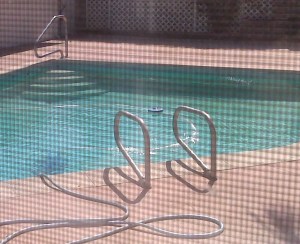
In the week I have not written, Sequoia relapsed on heroin, Winton started drinking and Ricky took his first paycheck and smoked it up on crack. Here’s the good news. My student Z is finally enrolled to take the GED in August. It’s her third and last time at the rehab and getting her GED could be life changing. She has a mind for social studies and math and she writes well, really loves learning. Her self-esteem goes up by increments and then plummets pretty quickly. She went swimming the other day and told me how she barely got through a whole lap. She struggled the last ten feet because of severe obesity and general lack of exercise. But I give her credit for getting in the pool. I told her, “This is like the GED. After you have tackled three hours of math and writing, they will hit you with science, reading, and social studies. It will feel like the last ten feet in the pool. But you can do it. Put the pencil down every 50 minutes and stretch you hands, close your eyes and take a breath, then pick up the pencil and start fresh. Don’t be a tired tester, don’t leave half the test section for the last ten minutes allotted.” I added, “You’re ready this time.”
Posted in adult education, drug recovery, GED, parolees, rehab, relapse | Leave a Comment »








 . . . . . . . . . . . . . . . . . . . . P A R O L E . C A L L