Archive for the ‘education’ Category
 December 29, 2012

Edgar made it to the GED and passed! I brought the class cupcakes. Then Edgar went home on a weekend pass and decided to celebrate his achievement by going on a methamphetamine binge. He crawled back to me looking a bit unshaven, the young man with the perfect goatee whom I had photographed in cap and gown just a week earlier. I admit I was disappointed in Edgar. Wasn’t the diploma enough? I have to re-enroll him so I gave him his former intake sheets to check. When I reviewed them later I noticed he left his grade level at 9th grade, didn’t bother to check the box for GED.
Now that Edgar has his GED I have to design a different curriculum for his 40 hours, the mandatory required in our particular program. It’s difficult to help someone climb a ladder only to have to pick them up again at the bottom. How do you make that ladder appealing now? Edgar told me he wants to move to Alaska when he discharges parole, to work in the oil industry. So I told him, “You need to read the classics,” and handed him Jack London’s Call of the Wild. I also directed him to an online literary guide that outlines the book’s characters and setting, with discussion and questions. I’m not finished helping Edgar but he’s got to help himself, break from the pack, the streets, crystal meth.
Posted in adult education, drug recovery, education, GED, meth | Tagged GED, parole, rehab and recovery, Self-help | Leave a Comment »
April 17, 2012

In the school where I work, every new student must go through an intake process that includes me asking them questions about their drug use and criminal history. The forms I fill out are important to the tracking and funding of our program and I always see this initial interview as an opportunity to get to know my students. On some days their words start to wash over me as the clients at the rehab often digress into personal tales.
“I have a detective coming to talk with me about being raped.” “I used meth and PCP together.” “The car accident, I can’t remember well.” “Seizures.” “I’ve been shot.” “I’m not here for drugs, I’ve had a terrible loss.” No one tells me they shot, robbed or beat someone — confessing their own misdeeds is a thin line few cross.
I have to remind myself that I am here to teach these guys and gals reading, writing and arithmetic. I’m not a social worker or a counselor, but I’m still empathic, intaking it all personally.
Posted in adult education, community, crime, drug recovery, education | Tagged parole, rehab and recovery | Leave a Comment »
September 16, 2010

I can’t count how many math tutors I have had on board over the years but one always seems to show up in the form of a smart student shortly after another has split. My last teacher’s assistant was great. Not only was Byron willing to help, he genuinely loved learning, and he was on deck to take his own GED.
When he arrived at the rehab, he asked me if I had a book on Origami. I bought him some Origami paper in a Japanese gift shop and printed the instructions for the crane off the Internet. He sat and made the most beautiful birds and taught others to make them as well. Soon my room had colorful Origami cranes tucked among the books and on the computer consoles. Then the cranes started to disappear. I asked one of my students if he knew where the green crane went? “One minute Ms. P.,” he said as he ran to his room to get the green crane that he had sprayed with very strong men’s cologne. “It’s the color of money,” he said as he returned it to its flock, “my favorite.”
Over the next couple weeks, the cranes Byron made vanished one by one. I always gave a crane to anyone who asked. Then last week, Byron didn’t show up to help tutor. He split two days before his own GED exam, left without permission. He probably neatly folded his few belongings and took flight.
Posted in adult education, education, GED, parolees | Leave a Comment »
July 13, 2010

I read on the Internet that when a kitten is weaned too early, it doesn’t get a chance to learn about acceptable (and non-acceptable) behaviors from its mom and littermates.
It just so happens that a litter was born four weeks ago at the rehab and I have woven this story into recent posts. At my break today I went to check on the kittens and was told they were all given away to family visitors over the weekend. There are two problems with this. One, they were much too young to be weaned from the mother; and second, I was promised the gray and white one. This is the first cat I would have had in 23 years and I got very attached to the idea of taking it home with me.
I leave work every Friday, and on Mondays I return to a board with the names of students who were kicked out of or simply walked out of the rehab. More often than not, one of my students’ names is listed on the board. I’m never really surprised or disappointed by who left because it comes with this kind of job. But to suddenly find the kitten I was promised missing really threw me for a loop. Even if the kitten miraculously returned I would put it back with its mother.
I realize that I am a bit of a mother figure to my students. I try to help them practice acceptable behavior, an attitude and manners that will help them in the workplace. When they get aggressive or needy I call them on it and steer them back to the reason they are in my school: holes in their early education. They were weaned too early from math and reading.
Posted in adult education, cats, education, math, parolees, reading | 1 Comment »
June 28, 2010

We hear a lot about meth abuse but math abuse damages people too. One of my students complained that every time he sat at the computer to practice long division he would get a pounding headache. Learning long division in your forties is enough to give anyone a headache, but I always see it as a red flag. I asked him, “Did you ever have a bad experience around math?” He sat and thought. “Yes!” he said with sudden awareness. “When I was young I would sit at the kitchen table doing my math homework. My mom would stand behind me and when I got a problem wrong she’d hit me on the back of my head.” As bad as this sounds it’s not that uncommon. Many of my students have traumatic math memories, from the teacher who humiliated them at the chalkboard to the parent who used math skills as a barometer of intelligence; they leave math in the dust and never look back.
Some of my students still need to memorize their times tables. Henry hates math and he begged me not to make him do it. “What happened to you?” I asked. “My elementary teacher promised us an ice cream sundae if we memorized our times tables,” Henry said. “I memorized them and she never came through, she never made good on her promise.” Although it wasn’t a strike to the back of the head, what Henry’s teacher did scarred him for life.
I tell my students math is a puzzle (they like puzzles) and when you get good at it, it actually becomes fun. My goal is to create math addicts.
Posted in adult education, education, math, parolees | Leave a Comment »
June 14, 2010

There is a workout room at the rehab, it looks more like a dirty garage filled with old iron barbells and antiquated equipment with torn padding. It’s the opposite of what most people think of when they imagine a gym. Sometimes I see my students working out when they are supposed to be in my class and I tell them, “When you’re done with your workout, come and exercise your brain.”
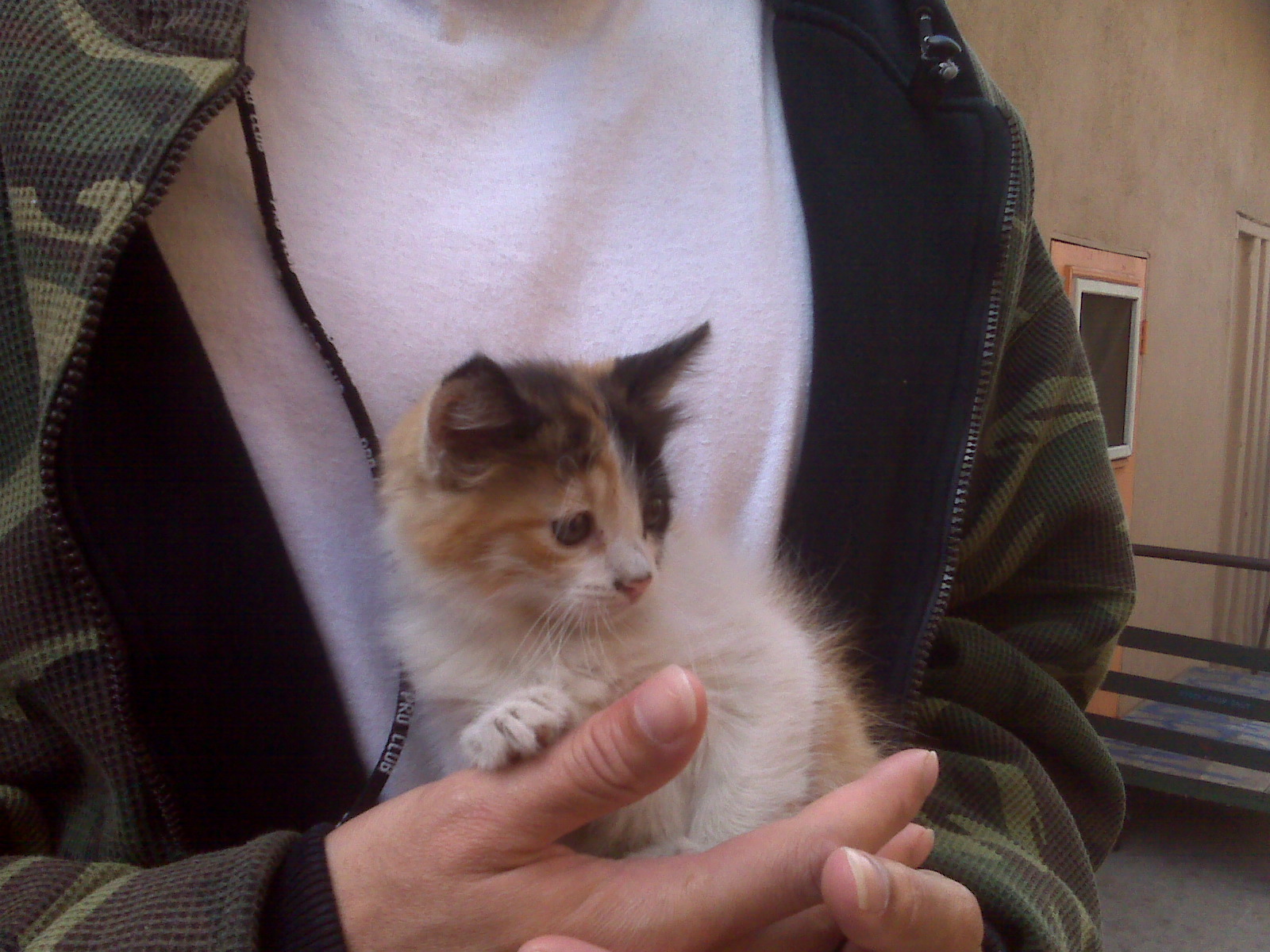
The other day I came by the weight room and found a resident sitting on one of the exercise benches feeding a newborn kitten with a tiny baby bottle. There are already three generations of cats who roam the property. The guys were hiding the latest litter of newborn kittens here in the gym, and back in the dorms had taken shifts all night feeding them by hand every two hours to keep them alive. A calico had given birth to the kittens the day before and ran off. She is a kitten herself, only 7 months old. She reminds me of how some of my students have struggled with their responsibilities as parents. When the mother cat came back the next day the guys made several attempts to get her to be with her babies and let them suckle, but she wouldn’t. I went and picked her up, very gently, and put her nose near the kittens. She immediately took them by the scruff of their necks and carried them under the storage shed. One by one, I got her to take all five newborn kittens under the shed. Like my students at times, the mother cat needed some old-school direct instruction.
Posted in community, education, parolees, rehab | Leave a Comment »
May 28, 2010

Coffee is my drug of choice. When new students enroll in my class I ask them their drug of choice. It’s part of our intake questionnaire. Caffeine is not an option on the form.
P.N. Witt, a German pharmacologist, researched the effect of caffeine and other psychoactive drugs on spiders in 1948. The study was repeated by NASA in 1995. I am astonished by the haphazard shape of the web built by the caffeinated spider. It has no center, no focus; it’s the result of effort without a clear definition or structure. It’s me at work multi-tasking.
I know what you are asking. How did they get the spider to drink so much coffee? Actually, ” The drugs were administered by dissolving them in sugar water, and a drop of solution was touched to the spider’s mouth. In some later studies, spiders were fed with drugged flies.” The jury is still out on whether coffee is good for us or not. But I couldn’t weave this here web without it.
Posted in coffee, drug recovery, education, parolees | Leave a Comment »
May 21, 2010

Today my Diogenes, who has turned out to be a pretty terrific student, asked if he could write a letter of intent to be allowed off property. He asked me to print a copy and I was so struck by it I read it aloud. “It reads like a police blotter,” I said. Here is an excerpt:
On May 13, 2010, on a Wednesday, Vincent, Fernando, and Emilio went to a book signing at the Library. During the reading these three students spoke out and asked questions during the Q&A. A teacher at a charter school approached them to see if they would like to be guests at her school to speak to the kids about gang prevention. The teacher offered to pick up the students and bring them back.
Diogenes, your case is convincing. I hope you get to speak at the school.
Posted in education, gangs, parolees, Uncategorized | Leave a Comment »
May 6, 2010

Traffic has been light in my school the past few days. Yesterday, I only had two students after lunch. Both of these gals, in their 40s, are low-level readers — between fourth and sixth grade. I busted out my new set of easy readers, choosing one titled Reading Changed My Life, which contains three true stories. I sat with my students at a circular table and we began to read the one told by a Mexican woman who comes to the United States as a child in a migrant farm family. Poverty, abuse, and violence pervade her story. Her father is an alcoholic who beats her. She marries a man who raped her and has a daughter. Growing up poor and itinerant she never learned to read. However all that changes when, after leaving her husband, she picks up her young daughter’s Dr. Seuss books and starts teaching herself to read. It nearly brought me to tears working with my students, helping them to brave reading aloud. For me the saddest part was not the horrors of the story we read together but the fact that my students see this is as everyday life.
Posted in adult education, education, literacy, parolees, reading | Leave a Comment »
April 29, 2010

I have a new worry about ordering the classics for my students. The old concern was that the antiquated language might turn them off. It turns out I missed a meeting where teachers were informed that the language in the novels on the list we can select from has been “modernized and simplified.” For example, in the crucial last paragraph of Homer’s The Odyssey, the line, “Odysseus obeyed Athene’s words, delighted at heart,” has been reduced to “Odysseus obeyed her gladly.” All this of course translated from the original Homeric Greek. I’m all for getting my students to read; the little bookshelf space I have in my class is at capacity. But to lose the poetry of Homer — having Odysseus cheerfully follow instructions as if he were talking to a receptionist at the dentist’s office — I’m not down with that.
Posted in adult education, education, parolees, The Odyssey | Leave a Comment »








 . . . . . . . . . . . . . . . . . . . . P A R O L E . C A L L