Archive for the ‘community’ Category

h1

Intaking it personally

April 17, 2012

In the school where I work, every new student must go through an intake process that includes me asking them questions about their drug use and criminal history. The forms I fill out are important to the tracking and funding of our program and I always see this initial interview as an opportunity to get to know my students. On some days their words start to wash over me as the clients at the rehab often digress into personal tales.

“I have a detective coming to talk with me about being raped.” “I used meth and PCP together.” “The car accident, I can’t remember well.” “Seizures.” “I’ve been shot.” “I’m not here for drugs, I’ve had a terrible loss.” No one tells me they shot, robbed or beat someone — confessing their own misdeeds is a thin line few cross.

I have to remind myself that I am here to teach these guys and gals reading, writing and arithmetic. I’m not a social worker or a counselor, but I’m still empathic, intaking it all personally.

h1

Fear factor

March 27, 2011

Randall had been at the rehab for years. He was a youthful-looking African-American in his forties who dressed like a kid. To me, It looked like his mom had picked out his clothes, typically plaid shorts, a crisp white polo shirt, and tennis shoes. His clothes always looked new, right off the rack. His drug of choice, heroin. He had worked his way up the ladder in the community, making sure, during hourly monitoring, that everyone was accounted for; manning the reception desk; answering phones; and eventually becoming a role model. In order to advance to intern, he had to have his GED and he studied sporadically in my school to take the test.

Randall is bright and he worked hard, passing the pre-GED in all five subjects. I recommended he be funded by the program to take the test, and he registered for for it. The morning of his test I saw him smoking out in front of the rehab. He told me he went to the testing center but was the only one who showed up, so they rescheduled the math and writing for next week. The odd thing is I believed him. After ten years working with parolees I somehow didn’t have my “cheater meter” up and running. Two days later coming in to work I saw his name on the board that lists the names of residents who split or were kicked out. Randall had left in the middle of the night. I called the GED testing center and they told me they’d had a full house for that week’s math and writing exam. Damn. My heart dropped.

It’s common for prisoners to mess up right before their release or to work toward a goal and sabotage it. They say success is the hardest thing for this population. Increased expectations, increased responsibility, increased fear. About the same time Randall left, most likely relapsing on heroin, I received a new student, Geraldo. Geraldo scored 100% on four of the five pre-GED tests. This is unprecedented in my experience. I immediately recommended him for the full test and he is set to take the GED next month. this time I’m not keeping my fingers crossed. Geraldo exceeds my expectations and I have no fear that he will succeed.

h1

77, but who’s counting?

December 30, 2010

Yesterday marked one year since I started Parole Call. My goal was 100 posts; counting this one I wrote 77. Anniversaries are funny things in my line of work. Mostly everything my students — all felons on parole — recognize as a milestone is followed by the statement, on the outside. “This is the first birthday/Christmas/Thanksgiving I’ve spent on the outside in X many years.” I’ve never heard anyone say, “This is the first anniversary of my not stealing.” Maybe we should honor the passage of time from iniquity as well.

So this is my first anniversary of blogging. I have learned a lot about my work through this process of written reflection. I realize I spend all day helping people see their potential, celebrate small victories, and recognize incremental growth in themselves. But I also see humanity in turmoil, locked into destructive patterns, unable to break away from drugs, poverty, and the grip of mental illness. My work environment is never boring. On any given day when I walk into the greater rehab, there is likely someone yelling, getting yelled at, crying, laughing, ready to walk, steaming mad, or heartbroken. I see people in survival mode, working the system for food and shelter. Some students leave without completing the program and come back years later, fresh out of prison all over again. I might see a former student sitting on the couch near the intake desk, black-eyed, thin and homeless. “Welcome back,” I say. “I hope you will come back to school, we missed you.” It’s about a thimble of hope.

h1

Jump in

October 31, 2010

Every day my work brings sweet surprises. I rely on volunteer tutors to help my students. They tutor in the classroom and sometimes outside of class, so students get  all the benefits of a private boarding school in parole housing. I’ve had many tutors over the years and most of them have been amazing.  One of my class tutors came back to say hi. She had one of my former students with her and they had news — they are now engaged and living together. They seemed stable, found jobs, were saving for a car. Though it is highly discouraged during recovery, relationships are formed in rehab, even here in my little one-room schoolhouse.

I recently lost my volunteer math tutor and found a new one in the community. A recovering cocaine addict, Khadim was raised in West Africa, speaks fluent French, Spanish and Yoruba. He went to universities in Africa and New York and has a degree in economics. He leaves early on Friday mornings to attend a Mosque dressed in beautiful African attire. He is over a foot taller than I. Very quiet, he waits for students to ask for his help. “Jump in,” I tell him, or I just call out his name, “Khadim!” Once he sits down and gets started, he’s one of the loudest people in the room, and I have to remind him, “Use your whispering voice.”

h1

Unusual fare

October 6, 2010

The females are required to eat lunch together as part of their recovery and bonding. Today Z asked if I would join them for my half-hour lunch break instead of my usual retreat to my classroom to read the newspaper online. No sooner had we sat down than trays appeared with sandwiches. “Who had the idea to make a BLT on cinnamon toast?” one of the women said, laughing. “It’s marble rye, ” I told them, “a real treat, something you might get in a New York Deli.” Then Z said Grace. The women were giddy over the unusual fare. Z somehow ended up with triple bacon. I also enjoyed some chicken soup and iced tea.

It’s very communal in our cafeteria. A handsome young Latina woman just out of prison with a shaved head got seconds and cut her sandwich in half with a spoon, giving half to her friend. I even gave my hot pepper away to my neighbor. Yet I felt conspicuous eating in front of my students. Z must have sensed that and smiled at me, saying, “You picked a good day to sit with us Ms. P — great sandwiches.”

h1

Stepping stone

August 27, 2010

Z passed the GED!! She ran into my room holding her scores in front of her, her hand on the paper shaking in excitement. I’m not supposed to hug my students, but after working with her for two years and close to 500 hours of preparation, I couldn’t help myself.

I wanted to take her picture. We dressed her in the black cap and gown I keep on hand. For my students, getting their GED and having their picture taken holding their diploma is monumental. For the better part of their lives they have faced the camera for mug shots holding their name and a number just below their face.

Z was invited to speak to the community. She said earning her diploma was the second greatest achievement in her life next to having children. Her children are all adopted out, I’m not sure of the circumstances behind this. I told her no one could take away her diploma but it was not in itself a destination. “It’s a stepping stone,” I said.

You don’t go into teaching to change people’s lives. You work in sales. I sell confidence, hope and determination. No guarantees.

h1

No time off

July 1, 2010

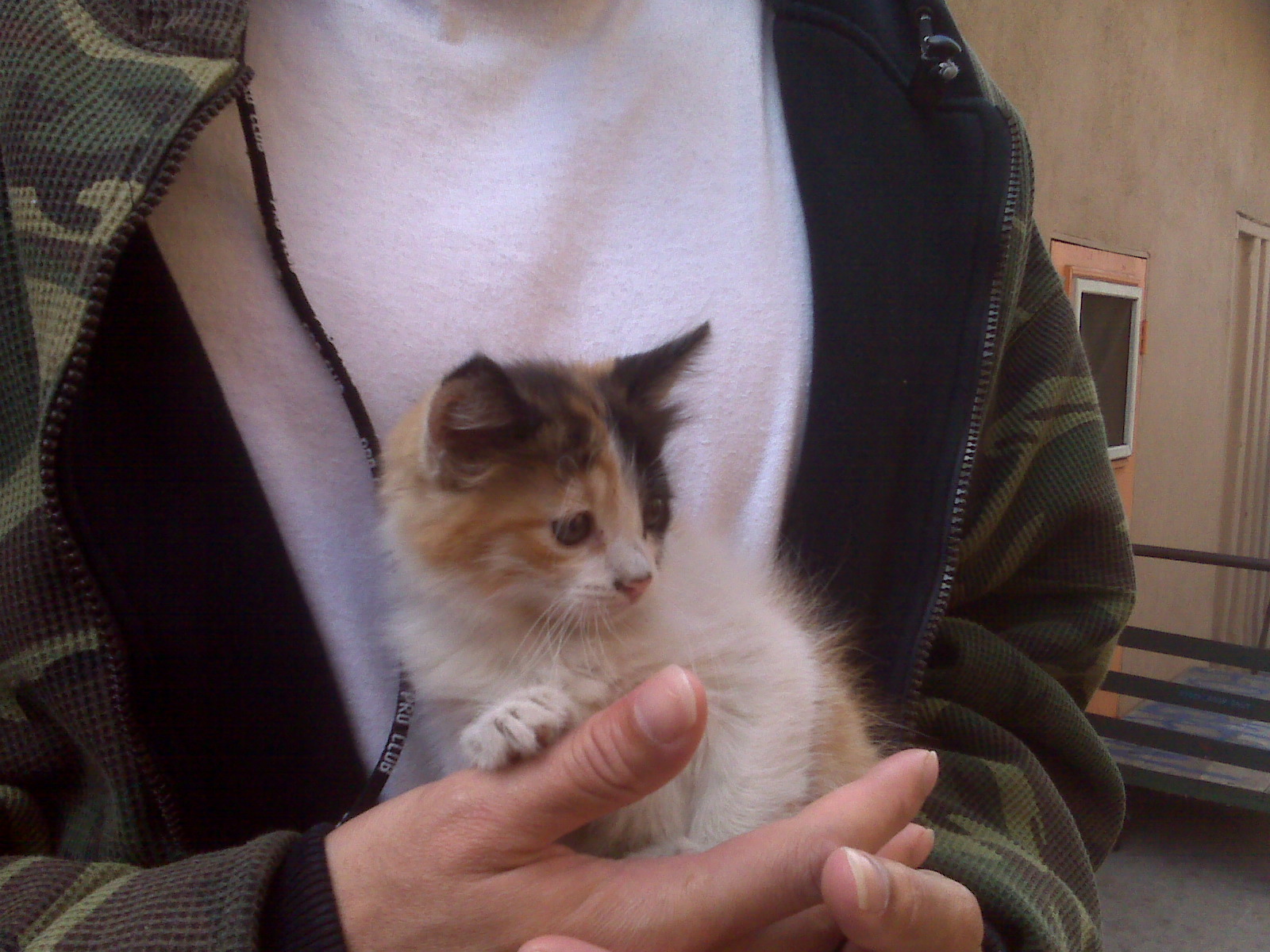
Six kittens! The calico mother cat has moved her litter to a high place in the shed accessible only by ladder. Today I climbed up and saw the kittens for the first time since I got her to begin taking care of them. I even snuck a quick picture. The guys set up a nice bed for them and have been cleaning out the kittens’ eyes and feeding the mother cat.

Meanwhile some of my other students are getting caught with cell phones, smoking pot in the dormitory and planning their exit out of the rehab. It’s a typical day with over a hundred residents on site. I am planning my own escape to a three-day weekend, one spent reading and writing — perchance to paint? Watercolors not my house, I’m not that ambitious. As for the new mother cat, she will not be getting any time off.

h1

Direct instruction

June 14, 2010

There is a workout room at the rehab, it looks more like a dirty garage filled with old iron barbells and antiquated equipment with torn padding. It’s the opposite of what most people think of when they imagine a gym. Sometimes I see my students working out when they are supposed to be in my class and I tell them, “When you’re done with your workout, come and exercise your brain.”

The other day I came by the weight room and found a resident sitting on one of the exercise benches feeding a newborn kitten with a tiny baby bottle. There are already three generations of cats who roam the property. The guys were hiding the latest litter of newborn kittens here in the gym, and back in the dorms had taken shifts all night feeding them by hand every two hours to keep them alive. A calico had given birth to the kittens the day before and ran off.  She is a kitten herself, only 7 months old. She reminds me of how some of my students have struggled with their responsibilities as parents. When the mother cat came back the next day the guys made several attempts to get her to be with her babies and let them suckle, but she wouldn’t. I went and picked her up, very gently, and put her nose near the kittens. She immediately took them by the scruff of their necks and carried them under the storage shed. One by one, I got her to take all five newborn kittens under the shed. Like my students at times, the mother cat needed some old-school direct instruction.

h1

Disposable cameras

June 4, 2010

My students love photographs. They still shoot with disposable cameras and get pictures developed. I always ask to see their photos — they tell me so much about who is in or not in their lives. Students show me snapshots of children they haven’t seen in years and long-dead parents. Herve asked me for a scissors today so he could trim the tattered edges off the picture he carries of his girlfriend. These photos are not sequestered in albums or frames. Some were literally posted on prison-cell walls with toothpaste for an adhesive. They are treasured touchstones to the outside world, the family as an imagined unit, the lover, the beloved auntie or the grandparents who raised them. I always appreciate what students share with me, even if  it’s not necessarily how it is.

h1

Goodbye Terry

June 3, 2010

Many of my students arrive at and leave our residential rehab with most of their worldly possessions in black-plastic garbage bags. Parolees are dropped off by parole agents with only the clothes on their backs and a few come direct from the jail in olive-drab jumpsuits. Here at the rehab they get to pick from bags of donated clothing. I’ve seen some wearing donated T-shirts with the anti-smoking message, “It’s Quitting Time,”  as they walk out to have a cigarette.

Terry left yesterday. She had the best fashion sense, really anything she threw together — whether store-bought or donated — worked. I didn’t realize she left because she never came to say goodbye. I hope it all works out for her with Slim, her boy on the inside, and most of all I hope she can shelter herself from the world of intolerance, of narrow-minded mediocrity.